AYAA · SMART POWER FOR UAVs
EF-007 12S 120A UAV BMS
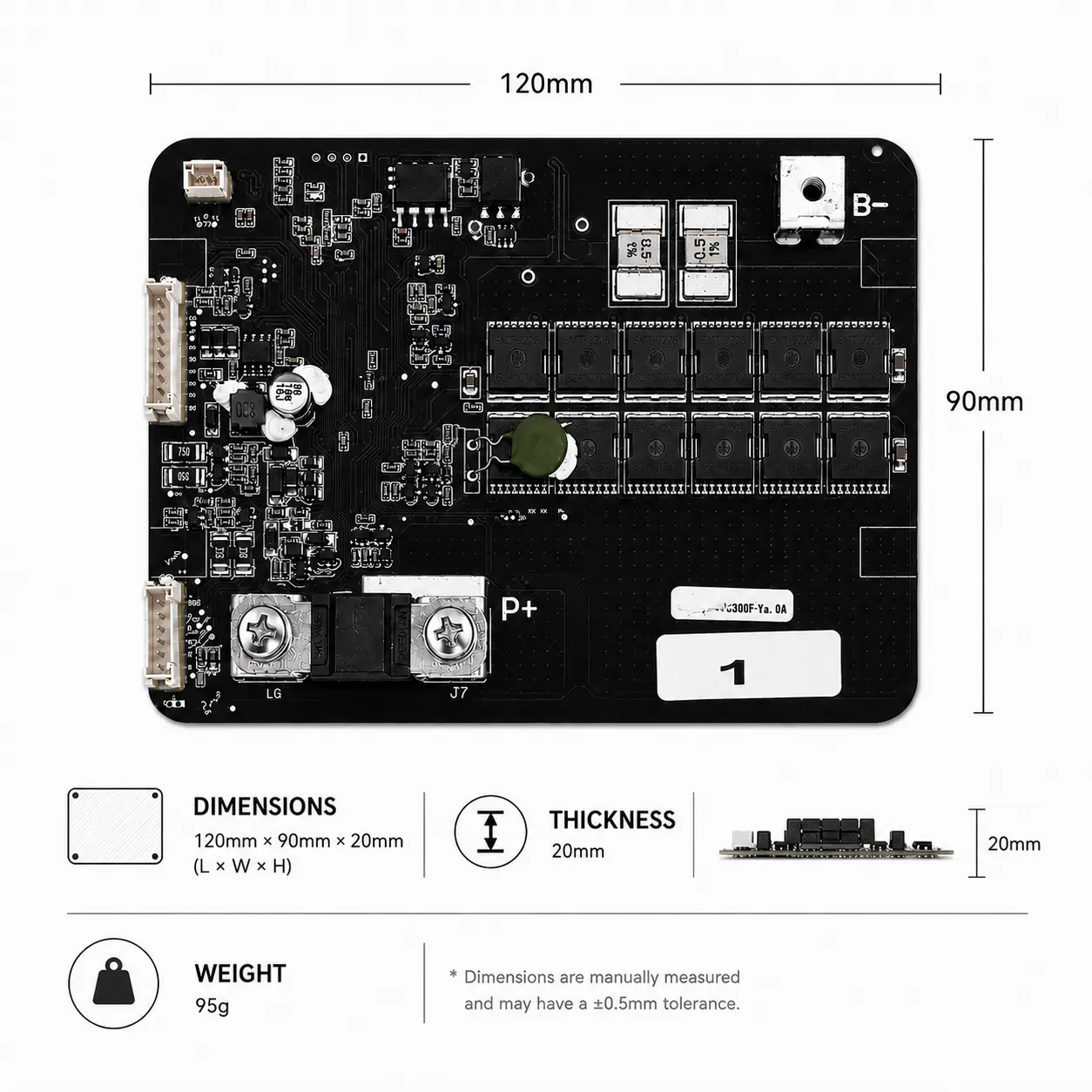
EF-007 is a common-port BMS for 12S NMC UAV battery packs, rated for 120 A continuous charge and discharge. It monitors cell voltage and temperature, provides passive balancing, and supports isolated CAN 2.0B, UART and Bluetooth.
Is EF-007 Right for Your 12S UAV Battery Pack?
12S PACK CONFIGURATION CHECK
Match the pack before integration.
Compare cell chemistry, maximum charge voltage, current demand, communication protocol and installation space with the EF-007 specification.
12S1P · 44.4 V UAV BATTERY PACK FAMILIES
Pack formats to evaluate with EF-007
EF-007 12S 120A Smart UAV BMS
For 12S NMC UAV packs: 120 A continuous charging and discharging, cell-voltage
and temperature monitoring, passive balancing, isolated CAN 2.0B/UART and Bluetooth data access.
ENGINEERING SPECIFICATIONS
EF-007 12S 120A UAV BMS Specifications
For a 12S NMC UAV pack, check cell charge voltage, 120 A continuous charge and discharge, common-port wiring, communication interfaces and mechanical fit before integration.
| Battery and Electrical Configuration |
Specification |
|---|---|
| Product Model | EF-007 |
| Battery Chemistry | NMC lithium-ion |
| Supported Cell Configuration | 12S |
| Nominal Voltage | 3.7 V per cell; 44.4 V pack |
| Specified Cell Voltage Range | 2.8–4.2 V |
| Maximum Pack Charge Voltage | 50.4 V (12 × 4.2 V) |
| Continuous Charge Current | 120 A |
| Continuous Discharge Current | 120 A |
| Port Configuration | Common charge/discharge port |
| Operating Temperature | −30°C to 70°C |
| Dimensions (basic parameter) | 95 × 85 × 25 mm ±1 mm |
| Measurement, Balancing and Communication |
Specification |
|---|---|
| Static Cell Voltage Accuracy | ≤5 mV at 25°C |
| Current Sampling Accuracy | ≤3% at 25°C |
| Temperature Sampling Accuracy | ≤2°C at 25°C |
| Temperature Inputs | 4 battery NTC + 1 MOS NTC |
| Passive Balancing Current | 70 mA typical |
| CAN Communication | Isolated CAN 2.0B; 1 Mbps; BMS ID 1 |
| CAN Termination Resistor | No onboard 120 Ω resistor |
| UART Communication | Isolated UART; 115200 baud; BMS ID 1 |
| Bluetooth Module | Standard |
| Run-State Consumption | ≤40 mA |
| Sleep / Deep-Sleep Consumption | ≤2 mA / ≤100 µA |
Protection, Communication & Battery Intelligence
Four operating scenarios for security-surveillance and border-patrol UAVs: in-flight temperature warning, anti-spark precharge, multi-protocol communication and high-accuracy SOC estimation.
IN-FLIGHT HIGH-TEMPERATURE WARNING
During flight, a high-temperature discharge condition triggers a warning without interrupting discharge.
PRECHARGE BEFORE MAIN-CIRCUIT CONNECTION
Reduce the voltage difference before the main circuit closes to limit inrush current and connector arcing.
MULTI-PROTOCOL COMMUNICATION
Support data exchange between the BMS, flight-control system and external engineering devices.
HIGH-ACCURACY IN-FLIGHT SOC ESTIMATION
Estimate the remaining battery capacity during flight to support mission and return planning.
CONNECTED BATTERY DATA
EF-007 CAN Communication, Host Software & Battery Data
EF-007 shares pack data over isolated CAN; its commissioning software provides live measurements, settings and fault history.
Confirm the flight-controller protocol, CAN bitrate and BMS ID. EF-007 has no onboard 120 Ω termination resistor.
Product Testing
EF-007 12S 120A UAV BMS Bench Test
See the EF-007 test setup and the host-software view of 12 cell-voltage channels, voltage spread and changing status indicators.
Standard EF-007 or a Custom UAV BMS?
Compare your pack with the EF-007 standard: 12S NMC, a 4.2 V/cell charge limit and 120 A continuous charge/discharge. For other requirements, request an engineering review.
Choose Standard EF-007
A 12S NMC lithium-ion UAV BMS with a common charge/discharge port and 120 A continuous charge and discharge ratings.
- 12S NMC Li-ion; max cell charge voltage 4.2 V
- 120 A continuous charge and discharge; common port
- Isolated CAN 2.0B and UART; Bluetooth module
- Cell-voltage and temperature monitoring; passive balancing
Discuss a Custom BMS
Share requirements that differ from the EF-007 12S NMC, 120 A continuous charge/discharge and common-port configuration for an engineering feasibility review.
- Different cell count, chemistry or charge-voltage limit
- Higher current demand or a different port arrangement
- Flight-controller protocol or interface changes
- Mechanical, harness or firmware constraints
Technical Resources, Support & Warranty
Download the EF-007 specification for electrical ratings, connection guidance, CAN communication, software functions and warranty terms.
EF-007 Product Specification
12S NMC UAV BMS, 120 A continuous charge and discharge, common-port layout, isolated CAN/UART, balancing and setup details.
Open Specification PDF →Wiring & Port Reference
Review the connection sequence and interface definitions. Confirm the sense-harness pinout for the selected hardware revision before assembly.
Open Specification → System ConnectionCAN & Host Software
Review isolated CAN 2.0B at 1 Mbps and BMS ID 1, plus host-software monitoring, settings and history functions.
Open Specification → Engineering SupportIntegration Checklist
Share cell chemistry, 12S configuration, continuous and peak currents, flight-controller protocol, harness and mechanical constraints.
Contact Engineering → Warranty12-Month Limited Warranty
Review the 12-month warranty for failures under normal use and its listed exclusions in the EF-007 specification.
View Warranty Terms →EF-007 12S 120A UAV BMS Engineering FAQ
What battery configuration and current rating is EF-007 designed for?+
EF-007 is specified for a 12S NMC lithium-ion UAV battery pack using 3.7 V nominal cells (44.4 V nominal pack). Its specified cell-voltage range is 2.8–4.2 V, and continuous charging and discharging are each rated at 120 A.
What is the correct EF-007 connection sequence?+
The specified power-up sequence starts with B- to pack negative, then the temperature, CAN and start-signal leads, followed by the cell-voltage sensing harness and the load/charger connection. After checking the revision-specific pinout and all connections, follow the specified 1 s K+ to K- shorting step. Use the documented power-down sequence for disconnection.
What CAN communication does EF-007 support?+
EF-007 provides isolated CAN 2.0B at 1 Mbps with BMS ID 1. It has no onboard 120 Ω termination resistor. Confirm the flight-controller message protocol, CAN wiring and bus termination before integration.
What battery data and functions are available in the host software?+
The host software displays individual cell voltages, pack voltage, temperature, current, SOC, remaining capacity and MOSFET status. It also supports protection and capacity settings, fault and operating-history review, data export and firmware updates over CAN or UART.
How does EF-007 passive cell balancing work?+
EF-007 uses passive balancing at approximately 70 mA. Once enabled, it balances the highest-voltage cell for 0.5 s in each 1 s cycle. Verify the balancing conditions against the selected cell specification during pack validation.
What warranty terms apply to the EF-007 UAV BMS?+
The specification states a 12-month warranty for failures under normal use. Exclusions include incorrect use, operation outside the specification, unauthorized repair, water or moisture damage, and a damaged or removed PCB barcode. Contact Ayaa for after-sales evaluation.
EF-007 vs EF-006: Compare 12S UAV BMS Current Ratings
Both models support 12S, 44.4 V nominal NMC battery packs. Compare continuous current, cell-voltage range, temperature sensing, balancing and CAN bus termination before confirming the pack and flight-controller integration.
| Selection Factor |
EF-007
12S / 120 A charge & discharge
|
EF-006
12S / 27 A charge, 81 A discharge
|
|---|---|---|
| Best-Fit UAV Application | 12S inspection or mapping UAV packs designed for 120 A continuous charge and discharge | 12S inspection, mapping or training UAV packs within 27 A charge and 81 A discharge |
| Supported Battery Configuration | 12S NMC; 44.4 V nominal | 12S NMC; 44.4 V nominal |
| Specified Cell Voltage Range | 2.8–4.2 V per cell | 3.0–4.2 V per cell |
| Continuous Charge / Discharge Current | 120 A / 120 A | 27 A / 81 A |
| Pack Integration Check | Validate the 120 A ratings against the cells, charger, power leads, connectors and thermal design | Validate the 27 A continuous charge and 81 A discharge ratings against the charger and mission load |
| Temperature Sensing & Balancing | 4 battery NTC + 1 MOS NTC with 70 mA typical passive balancing | 3 battery NTC + 1 MOS NTC with 50 mA typical passive balancing |
| Communication and Integration | Isolated CAN 2.0B at 1 Mbps, isolated UART and BLE; no onboard 120 Ω CAN termination | Isolated CAN at 1 Mbps and BLE; onboard 120 Ω CAN termination |
| Choose This Model When | Your validated 12S design needs up to 120 A continuous charge and discharge, or four battery temperature inputs | Your 12S design stays within 27 A charge and 81 A discharge and uses three battery temperature inputs |
| Request EF-007 Review → | View EF-006 Details → |
EF-007 UAV BMS INTEGRATION
Confirm Your
EF-007 Integration
Share your 12S pack chemistry, cell charge limit, charger output, current demand and flight-controller protocol. Our engineers can review the 120 A charge/discharge ratings, CAN wiring and mechanical fit for your EF-007 project.

EF-006
12S / 27 A charge, 81 A discharge